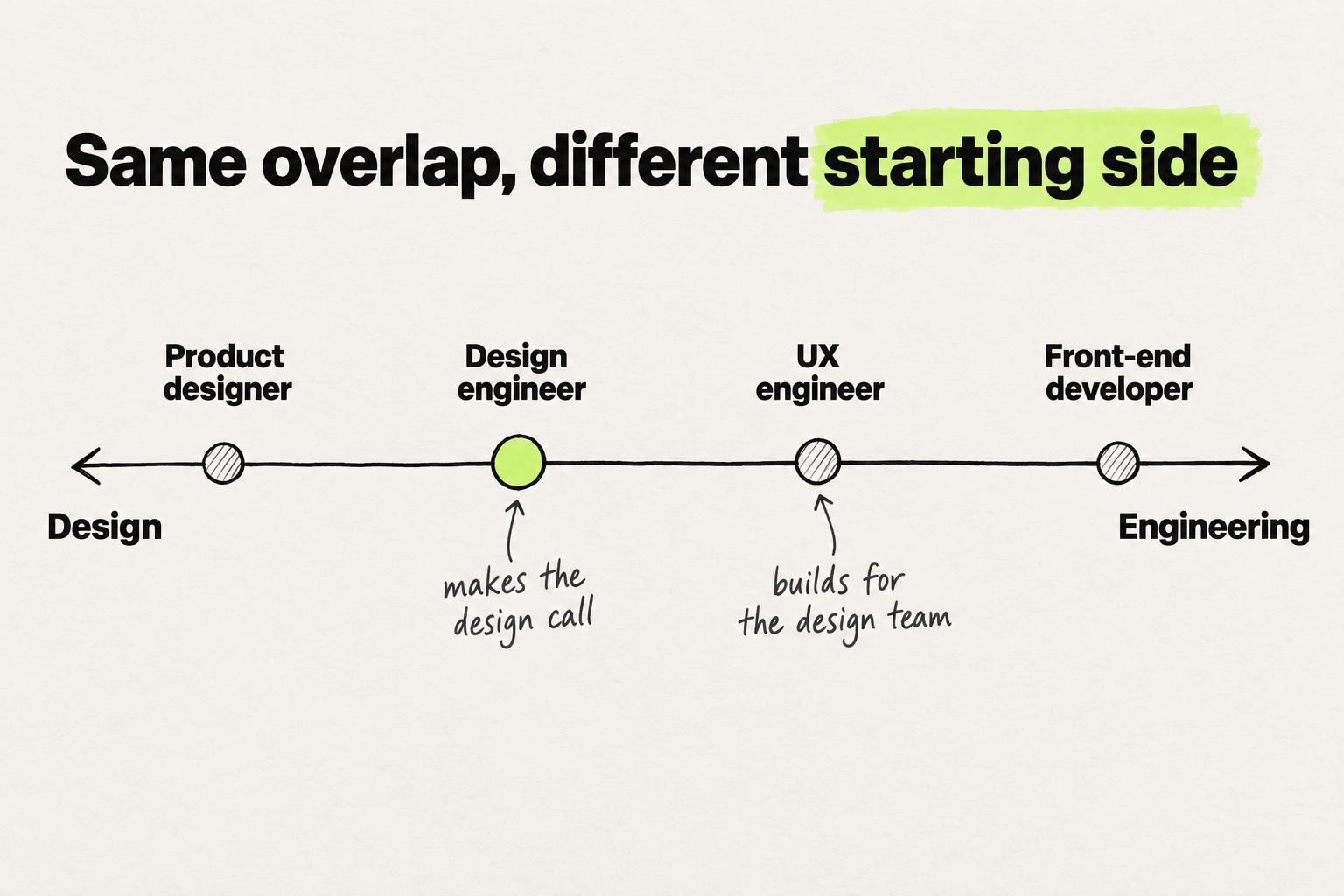
A UX engineer is a front-end engineer who works for the design team. They build prototypes that answer designers' and researchers' questions, plus the components and tools the design team needs, and help carry the result into production code. A design engineer is the designer: they make the design decision and ship it themselves. The two roles meet in the same place and start from opposite sides.
That difference decides who you hire, which title to aim for, and how each role changed once AI made building cheap. This post covers the UX engineer side. What a design engineer does all day covers the other side.
Key takeaways
- "UX Engineer" is the title Google hires under. Google describes UX engineers (UXEs) working through two lenses, design and engineering (Google Design), and hires them onto multi-disciplinary UX teams.
- Google Careers listed nine UX Engineer postings in September 2026, from interns to staff level (Google Careers).
- A UX engineer builds what the design team needs, and Google's postings say UXEs "build tools to accelerate UX teams". A design engineer makes the design call and ships it. A front-end developer is measured on how the product works.
- AI made prototypes cheap for everyone. Google's current UX engineer postings ask for design systems, AI-native interfaces and agentic developer tools (Google Careers).
What is a UX engineer?
Definition
A UX engineer is a front-end engineer who works inside a design team. They build the prototypes, components and tools that designers and researchers need, and help carry the design into production code.
Google is the best-known employer to use the title, and still the clearest reference. Its UX Engineering site tells candidates "you'll combine your design, engineering, and product intuition". It adds that "a big part of your job is to bridge the gap between what is being designed and what goes into production."
Google Design's profile of the role splits the work into two lenses. Through the design lens, UXEs build prototypes that designers explore and researchers put in front of users. Through the engineering lens, they write production UI code, maintain the team's UX library, and handle performance. Min-Zhong Lu, a UXE in that piece, puts it plainly: "'Engineer' is in the job title for a reason, even for people who only write prototype code."
Prototyping is the thread through all of it. The same piece says "prototyping is one of their superpowers". A UX engineer is the person a designer asks when a static file cannot answer the question.
The short version, and the one this post defends: the UX engineer serves the design decision, and the design engineer makes it.
Who hires UX engineers?
Google is the reference employer for the exact title. Google Careers listed nine UX Engineer postings in September 2026, across Search, Chrome, a design systems team and a summer internship.
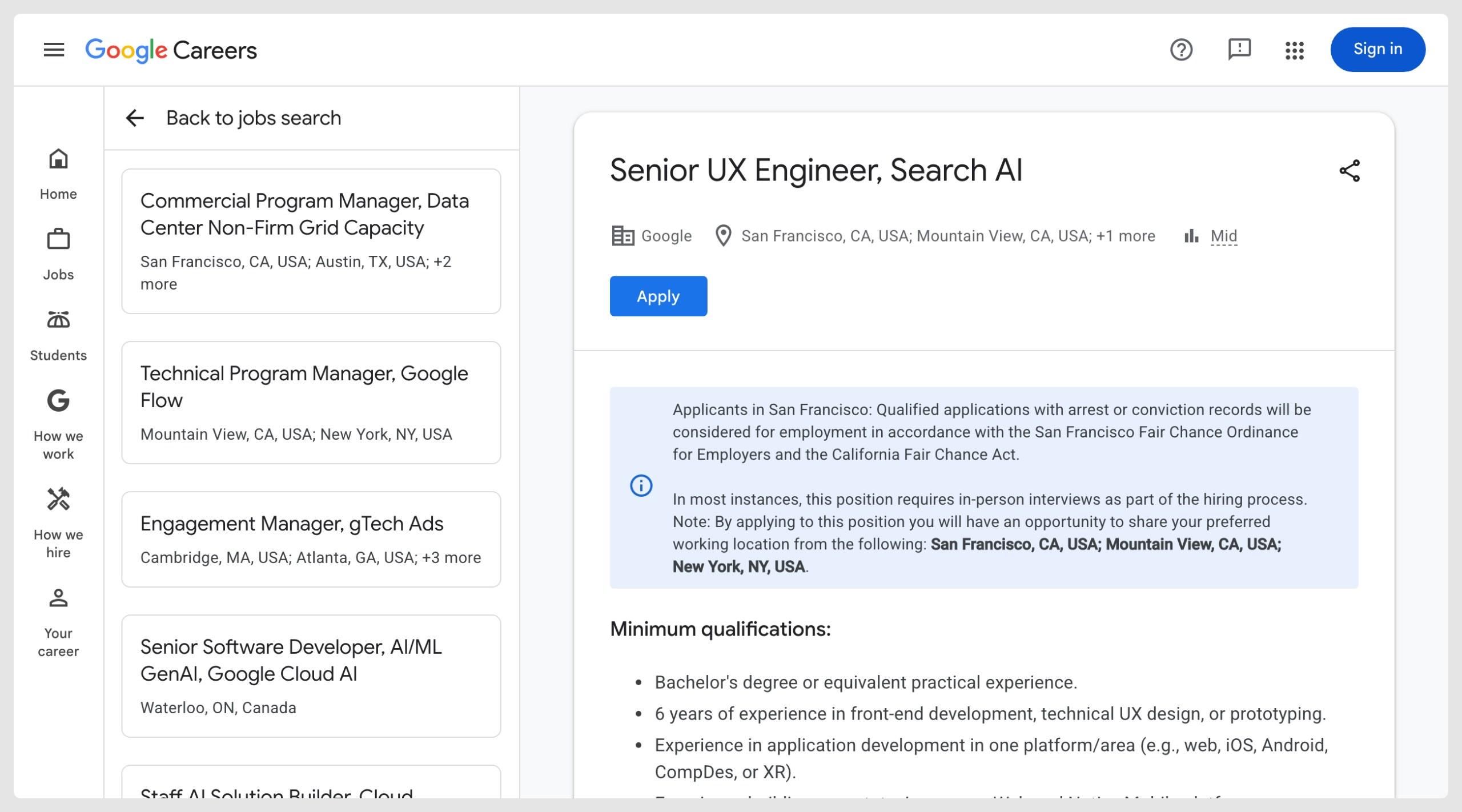
Google's UX Engineer postings share one description. UX engineers are "driven to advance the vision for our design teams", and the role is "joining a multi-disciplinary UX team" that works with Engineering and Product Management. So at Google a UXE sits with design and is hired as an engineer.
That has also been a separate career track. In 2019, Steve Paulo, then at Google, wrote: "At Google we have Front End Software Engineers and UX Engineers to attempt to address these differences." The two career ladders, he added, are "very different". Chris Coyier quoted him in The Great Divide.
Outside Google, the title is looser. UXPin notes it is "also called a UI engineer or UI or UX engineer". Alyssa Nicoll at Telerik sees "UX," "design" and "frontend engineer" used interchangeably on job listings. UXPin describes UX engineers as "generally front-end developers who understand design thinking and design principles". Read the responsibilities, not the title. The design technologist, a third neighbor, overlaps with both roles. How design technologists compare is its own question.
What does a UX engineer do all day?
A UX engineer's day moves between design reviews and a code editor. Google's own list of a typical day has four items: production UI code, prototypes for design projects, design exploration with UX designers, and study prototypes with researchers.
Across Google's site, its design profile and its current postings, the work falls into five kinds:
- Prototypes for questions. A designer wants to know how a gesture feels, or a researcher needs a working flow with real data for a study. The UXE builds it.
- Design system components. Reusable components, motion and tokens that the whole product uses. Google's Search AI posting asks for motion tokens systemized into the Search Design System.
- Tools for the design team. Tooling and pipelines that, in the words of Google's Search AI posting, "dramatically shorten the design-to-implementation timeline".
- Production UI. Some UXEs ship features directly. Google's Chrome Desktop posting says "Write and review code in Chrome's codebase."
- Translation. Telling designers early what is feasible, and telling engineers what the design needs. In Google Design's profile, Aaron Zemach calls UXEs "a communication bridge".
What a UX engineer usually does not own is the design call itself. They advise, prototype and build, and a designer decides.
What skills does a UX engineer need?
A UX engineer needs front-end engineering first and design literacy second. Google's current postings are consistent on the core:
- Front-end development: HTML, CSS and JavaScript, TypeScript on the web, and SwiftUI or Jetpack Compose for native mobile work. The minimum is years of "front-end development, technical UX design, or prototyping".
- Prototyping at speed: fast, disposable builds that answer a design question, with real data when a study needs it.
- Motion and interaction: the Search AI posting names spring physics, gesture dynamics and rendering performance.
- Design systems and accessibility: component libraries, tokens and "high accessibility standards".
- Working across disciplines: the Chrome Disco posting asks for a portfolio link, and the internship accepts students of Computer Science, HCI or Design.
Google treats the neighboring titles as equivalent experience. Several postings prefer years "as a front-end developer, UX Engineer, creative or design technologist". Pay and career moves for these roles have their own chapter.
UX engineer vs design engineer vs front-end developer
The three roles share the front end and differ in where they start, who owns the design decision, and what they are measured on.
| UX engineer | Design engineer | Front-end developer | |
|---|---|---|---|
| Starts from | Engineering, with a design lens | Product design | Engineering |
| Usually sits in | The UX or design team | The design team, or a product team | The engineering team |
| Owns the design decision | Usually not. Advises and prototypes | Yes | No |
| Main output | Prototypes, design system components, tools for UX teams | A pull request with the designed change | Features, data flow, front-end architecture |
| Measured on | How fast the design team learns, and craft | Whether the shipped UI matches the intent | Logic, performance, reliability |
| Typical path in | Front-end developer drawn to design | Product designer who started shipping | Computer science or self-taught engineering |
| What AI changed | Prototypes got cheap, so the work moves to systems and AI-native interfaces | The designer can ship through an agent | More code to review, same accountability |
UX engineer vs design engineer
The difference is who owns the decision. The design engineer is defined from the design side:
A design engineer is a product designer who designs in code and ships their work to production through pull requests, instead of handing off mockups for engineers to rebuild.
A UX engineer can build the same screen with the same care. They build it for a designer who decided what it should be. The design engineer decided, then built it. The design engineer role, explained covers a design engineer's day, the two hiring tracks, and what the role is not.
Design engineer vs front-end developer
The difference is the expectation of design skill. In the Q&A after his Hatch Conference 2026 keynote, Mehmet Baytaş answered this question directly. Some companies do not need their front-end engineers to be good at design, he said. Some have a strict design system, and some do not care. Companies that care about design name the role design engineer.
roadmap.sh's front-end guide says the same thing from the other side. In some companies the front-end developer is also a skilled designer or UX engineer, but "those are not the typical profiles". Its learning path for front-end developers is coding practice and architecture.
UX engineer vs front-end developer
Both are engineers. The difference is who they serve. A front-end developer builds the product with the engineering team. A UX engineer builds for the design team, and Google hires them under their own title. Coyier's piece quotes Steven Davis proposing a similar split: "UX Engineers and JavaScript Engineers. They are different mindsets."
How AI changed the UX engineer role
AI put the UX engineer's most visible job, the working prototype, within everyone's reach. For years, one big reason to have a UXE was that most designers could not build a working prototype themselves. The AI in Design Report 2026 now describes "a world where anyone can spin up a prototype".
The design teams we talk to are trying to get their own designers closer to code, with Cursor, Claude, Codex or Copilot and the Figma MCP server. They find it slow going, because the coding agents and MCP setup are still hard for designers.
The title did not disappear. Google still hires under it, and its postings show where the work moved:
- AI-native interfaces. The Search AI role builds interactive sandboxes that test "latency under real-world LLM streaming conditions". The Chrome Disco role will "own the craft of key AI-native browser surfaces".
- Systems, not one-off prototypes. Motion tokens, design system components, and "tools to accelerate UX teams", in the words of the shared posting description.
- Agents in the workflow. The Search AI role prefers experience with "agentic developer tools" in daily engineering work.
Design engineer postings moved the same way from the other side. In September 2026, Vercel's design engineer posting for AI Gateway said the hire will "use coding agents to explore and implement ideas quickly" (Vercel). Linear asks for "agentic coding tools as part of the design process" (Linear).
Our read: if designers can prototype with an agent, fewer prototypes need a UX engineer. The UX engineer is becoming the person who builds the system that designers and agents build on. The design engineer is the designer on the other end of that system, shipping into it.
Which one are you, and which one should you hire?
Pick by who owns the decision and who needs the code.
- You are a product designer and want your work to ship. Aim for design engineer. You keep the design call and add the pull request. The new design ladder shows where you are on the way.
- You are a front-end developer who cares about craft. UX engineer fits if you like building prototypes and design systems for designers. Design engineer fits if you want to own the design as well.
- You lead a design team that needs prototypes and design system tooling. Hire a UX engineer.
- You want designers who ship their own changes. Grow design engineers from your product designers. The guide to becoming a design engineer is the path.
- Your design system is strict and design is decided upstream. A front-end developer may be all you need, which was Baytaş's point.
Frequently asked questions
Is a UX engineer a designer or a developer?
A developer. Google hires UX engineers against front-end engineering experience and places them on UX teams. They bring design literacy to the work, but a designer usually owns the design decision.
What is a UI UX engineer?
Mostly another name for a UX engineer or a front-end developer with design duties. UXPin lists UI engineer and UI or UX engineer as synonyms for the same hybrid role. Read the responsibilities to see which one a posting means.
Is a UX engineer the same as a design engineer?
No. Both work where design and front-end code meet, but they start from opposite sides. A UX engineer is an engineer who builds for the design team. A design engineer is a product designer who designs in code and ships their work to production through pull requests, instead of handing off mockups for engineers to rebuild.
Do you need a computer science degree to become a UX engineer?
Not at Google. Its experienced-hire postings ask for "Bachelor's degree or equivalent practical experience", and its internship accepts students of Computer Science, HCI or Design. What the experienced-hire postings do require is years of front-end development, technical UX design or prototyping.