You finish the screen, hand it over, and wait. What comes back is close but not right, the fixes go in a backlog behind someone else's sprint, and the design that ships is not quite the one that was approved. Every designer working through a handoff knows that loop.
A design engineer does not have it. They work in the software product's real codebase, so the design and the build are the same artifact, and what they hand over is a pull request. This chapter of the full guide to becoming a design engineer covers the job, a working day, three neighboring roles, and what it is not.
What is a design engineer?
In two years, "design engineer" went from a niche title at a few companies to something a growing share of designers on LinkedIn put in their bio. The role is real, and the title now means whatever the person using it wants it to mean. Ask ten people and you get ten answers. A front-end developer who likes Figma, a designer who once wrote CSS, anyone who has opened Cursor, someone senior enough that nobody dares to check.
A design engineer is a designer with a bias to shipping. Give them a screen and their brain does not stop at "how should this look". It carries on to "how does this get into production, and what is in my way". Most designers have been trained out of that question, because the handoff exists so they do not have to ask it. Design engineers never quite accepted it.
Before AI, acting on that instinct meant learning to code properly, which took years and turned a lot of good designers into mediocre engineers. Now it means staying a designer and getting good at making an agent do the engineering.
The definition names three things. They design: they own how the product looks, feels and behaves, including every state a screen can be in. They design in code: in the product's real codebase, with its real components and tokens, rather than in a separate mockup tool. They ship: the deliverable is a pull request that engineers review and merge, which is why designing in code does not make them a software engineer.
The other definitions, and who holds them
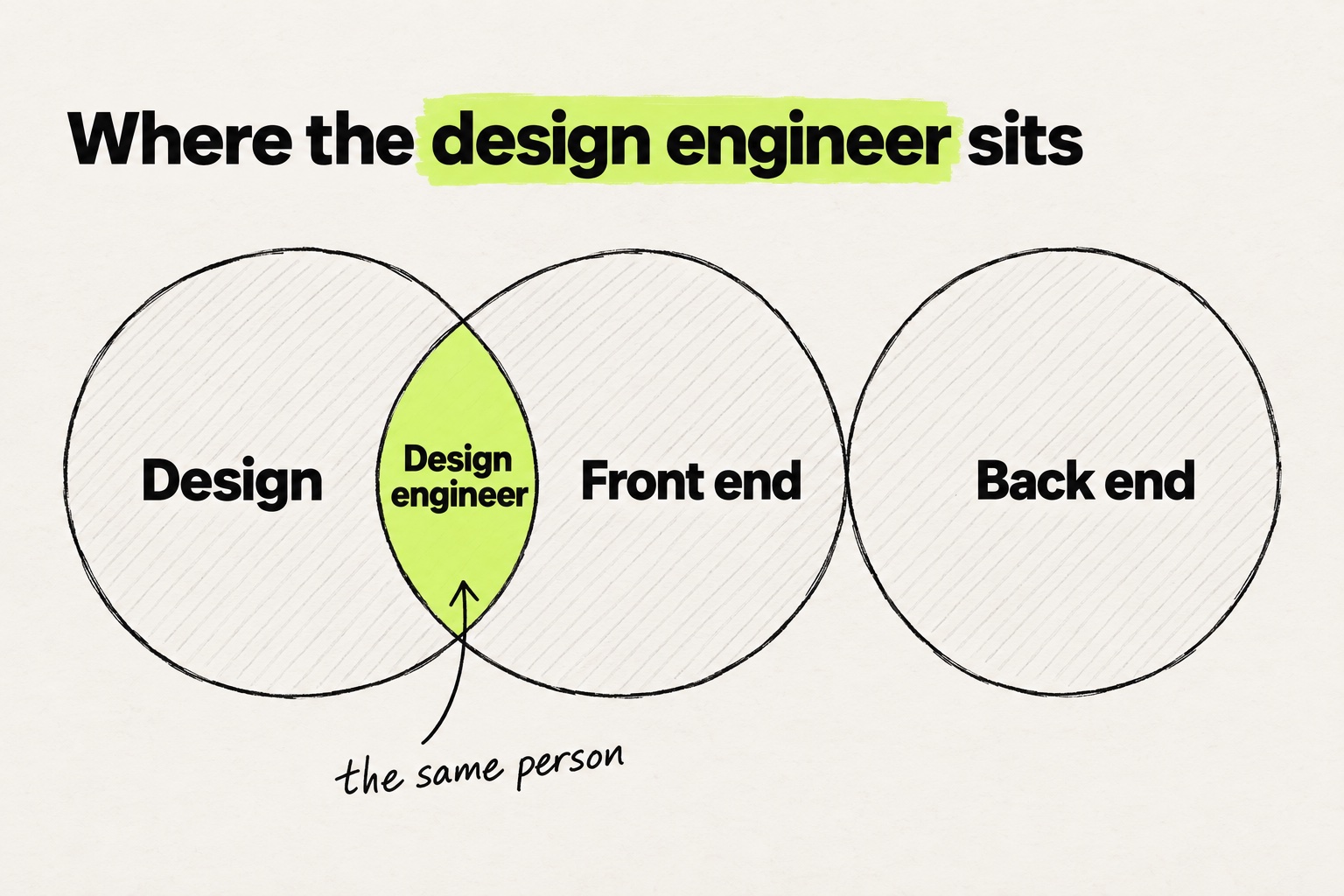
The term has at least seven working definitions in circulation, and they disagree on emphasis rather than substance. Every one describes a person who sits where design and front-end code meet. They differ on which side that person starts from, and on what counts as done.
Most of them start from the engineer. Vercel (2024) describes a blend of aesthetic sensibility and technical skill, shipping autonomously, and the folk shorthand for it is "engineer with taste". The same wording turns up in Vercel and Linear job posts. Google names the role after the engineer and gives it a designer's lens: its UX engineer has two lenses, developer and designer, and sits on the engineering ladder.
Others describe a hybrid without saying which side it grew from. Maggie Appleton (2024), the definition Wikipedia cites, names a hybrid who can run a design process and implement it. Kathryn Gonzalez at DoorDash (2024) names three attributes instead: autonomy, craft and fidelity. Jeremy Keith (2021) and David Luhr (2024) describe the meeting point itself, the handshake between design and engineering, and take no side.
Only the 2026 entries start from the designer. Ioana Teleanu (2026) and Yaron Schoen (2026) both describe a designer who can build their own solutions end to end. Paul Bakaus at a16z (2026) puts a reason under it: designers are becoming design engineers because the work moved into the codebase. The timing is not a coincidence. AI agents made building cheap enough for designers to try.
This guide starts from the product designer and names the deliverable. A product designer reading Vercel's definition sees a job they cannot apply for, and reading this one sees a next step. The deliverable closes a second gap: "ships autonomously" and "can implement it" leave room for a prototype that never merges, and a merged pull request does not.
What a design engineer is good at
Not code. Prompting. But prompting in a specific way that most people never get to, and four other habits that turn a prompt into a merged change.
They prompt like an engineer. A bad prompt says "make the settings page look like the design". A design engineer's prompt says "update SettingsPanel to use Card from our design system, spacing tokens from theme.spacing, and match the empty state in NotificationsPanel". Same intent, completely different result. The difference is specificity, which comes from knowing what exists.
They know their codebase. They could not rewrite it, but they know where the components live, what they are called, and which ones are the real design system versus someone's Friday afternoon hack. This is what separates a designer who prototypes from one who ships: one describes components, the other points at them.
They break work down. They do not ask an agent to "build the onboarding flow". They ask for the layout first, then the states, then the validation, then the responsive behavior, checking each step against the design. Engineers do this because they have been burned. Design engineers do it because they have watched an agent confidently produce 400 lines of nonsense from one vague sentence.
They can read what came back. The styling, if not the logic. They open the output and can tell whether it used the token or hardcoded #1a1a1a. Whether the button is the real Button or a div pretending to be one. What they can catch is the agent cutting corners on the thing they care most about, which is fidelity.
They can get from prototype to PR. They understand the basics of the loop: branch, change, commit, open a pull request, respond to review. Enough to move their own work through the door.
What does a design engineer do all day?
Most of the day is spent in the codebase, not in a mockup tool. The artifacts are branches and pull requests, and the design exploration happens on the real screen with real data.
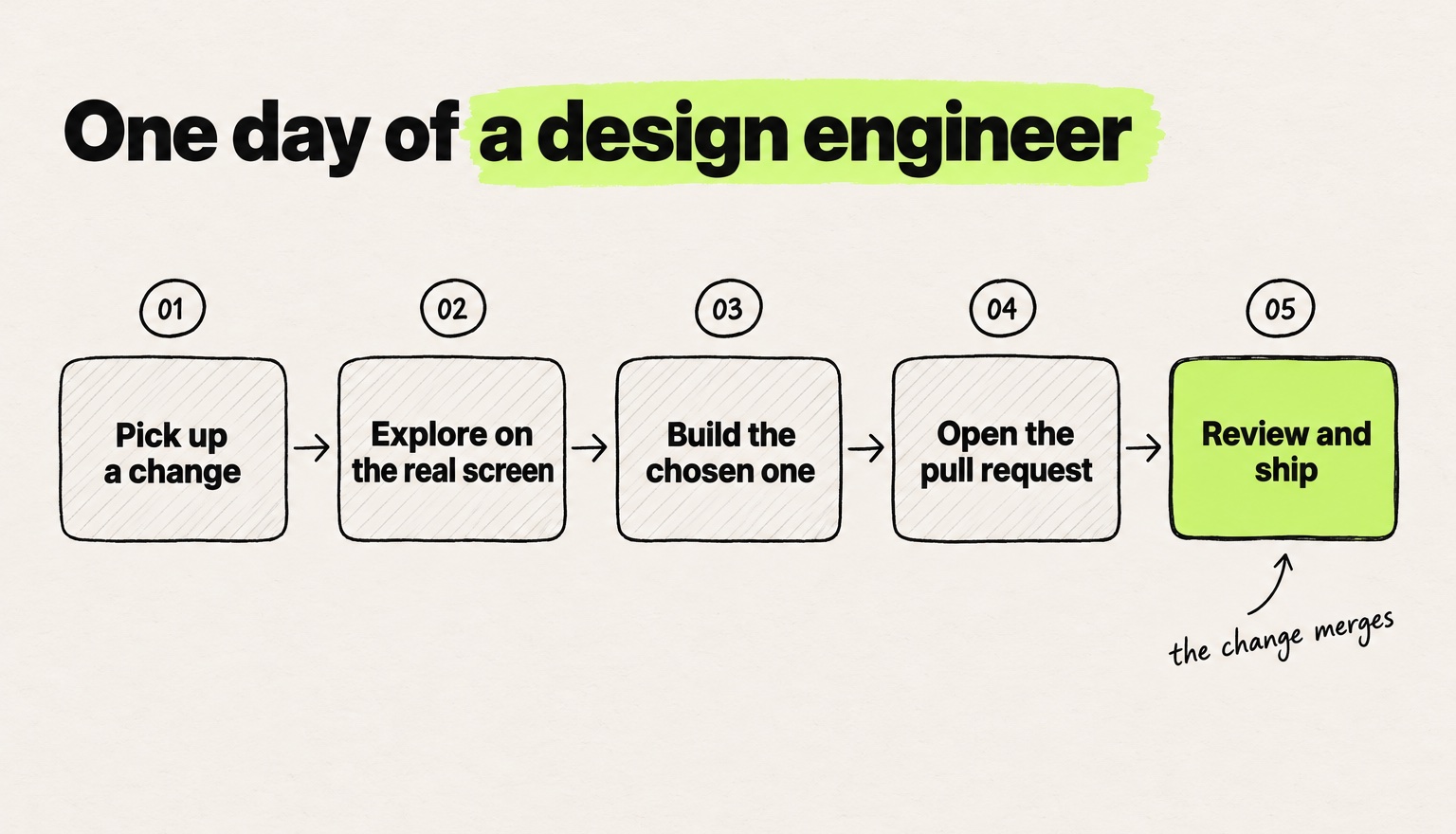
A working day breaks into five blocks, and not every day has all five.
- Pick up a change. It comes from the backlog or a design QA finding: a state that drifted after a refactor, spacing that no longer matches the system, an empty state nobody designed. The design engineer pulls the branch and opens the screen with real data.
- Explore on the real screen. Two or three variants, built from the team's own components and tokens. Each one is a diff, so variants are cheap, and the rejected ones are deleted rather than archived in a page of frames.
- Build the chosen one. Hover, focus, loading, error, empty, and every breakpoint. The agent does most of the typing. The design engineer decides what changes and checks the result against the design system.
- Open the pull request. A short description of intent, screenshots or a preview link, and the states covered. This replaces the handoff document, the redlines, and the Dev Mode inspection.
- Review and ship. An engineer reviews for logic, performance and conventions. The design engineer fixes what comes back, and the change merges.
The industry is moving toward this loop without always naming it. In the Designer Fund and Foundation Capital AI in Design Report 2026, 43% of the 900+ designers surveyed said a working prototype is an expected deliverable. A prototype falls short of a pull request, but once the expected deliverable runs, the distance to something that merges is a review rather than a rebuild.
Product design engineer vs marketing design engineer
Companies hire the title on two tracks, and the two do different work. The product track works inside the app's codebase, on the features customers use. The marketing track builds the website, the brand, launch pages and motion work, usually in a separate repository.
Two postings open in September 2026 show the split. Vercel's Design Engineer sits in the Design department and owns one product surface, AI Gateway. The posting asks for "product design and frontend implementation", with a product manager and a dedicated engineering team alongside. Linear's Design Engineer (Web & Brand) sits on the Magic team, which Linear calls its internal creative agency. That job builds websites and landing pages, and implements "creative animations and interactions in code". Same title, two different jobs.
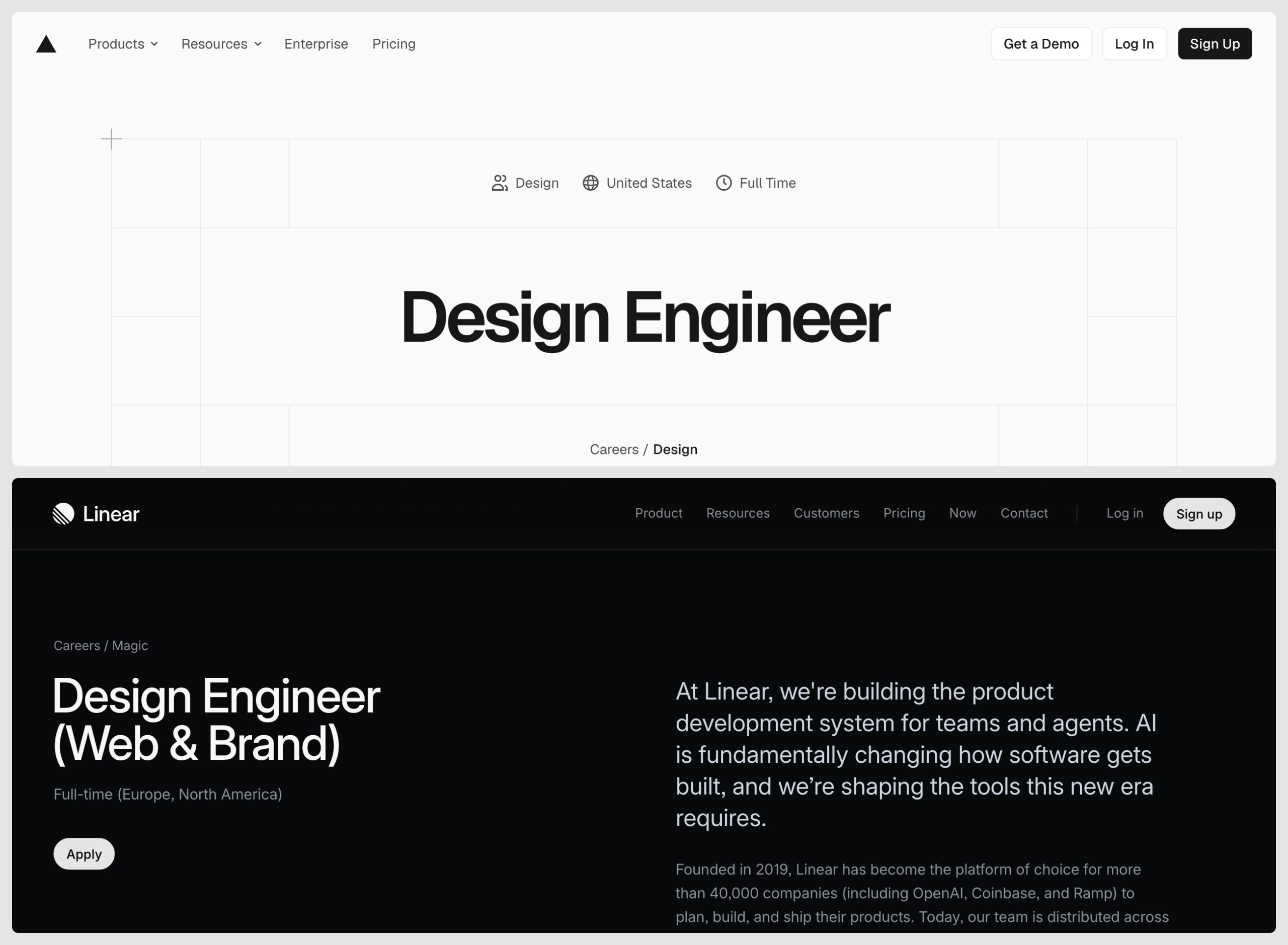
Both companies keep their openings at vercel.com/careers and linear.app/careers.
A marketing design engineer is closer to a creative developer: motion, campaign pages, a high bar on visual craft, little contact with product data and states. A product design engineer lives in the design system and the feature backlog. The skills overlap, but the day does not, and this guide is about the product track.
In September 2026, designengineer.io carried about 45 postings across both tracks and designengineerjob.com about 50. LinkedIn and Indeed counts for the title are dominated by mechanical roles.
Design engineer vs UX engineer, front-end developer and product designer
The four roles differ in where they start, what they own, and what they hand over.
| Design engineer | UX engineer | Front-end developer | Product designer | |
|---|---|---|---|---|
| Starts from | Product design | Engineering, with a design lens | Engineering | Product design |
| Owns | The UI layer in the product's codebase: look, feel, states | Prototypes, design system tooling, front end for research | Logic, performance, data fetching, front-end architecture | The design: flows, layout, states, on a canvas |
| Main artifact | A pull request | A prototype or a component library contribution | A pull request | A Figma file and a handoff |
| Review | Reviewed by engineers on code, reviews UI | Both, depending on the team | Reviews others' code, reviewed on logic and performance | Presents, is critiqued, files design QA tickets |
| Tools | The product repo, an agent, the design system in code | Prototyping frameworks, the design system, research tooling | The full front-end toolchain | Figma, prototyping tools |
| Typical path in | Product designer who started shipping | Front-end developer drawn to design | Computer science or self-taught engineering | Design school, UX, visual design |
UX engineer is Google's name for a neighboring role. The uxe.withgoogle.com description gives it two lenses, developer and designer, and places it on the engineering ladder. The roles overlap heavily, and the difference is mostly which ladder the person is measured on.
A front-end developer owns logic, performance and infrastructure, and is reviewed on those. Many build UI well, so the difference is accountability. A front-end developer who ships a feature with drifted spacing has done their job. A design engineer who ships the same feature has not.
A product designer whose output stops at Figma is the role most design engineers came from. The taste, the process and the ownership carry over unchanged. What changes is the material: components and tokens instead of frames, and a pull request instead of a handoff. The three rungs chapter maps that transition.
What a design engineer is not
Most definitions go wrong at the edges, so this section spends its time there. Clarity about what the role excludes makes it safe to hire for and to grow into.
It is not a developer. A design engineer does not understand code at a low level and does not pretend to. They do not know how the state management works or why the build is slow. They are not a cheaper front-end engineer, and any team that treats them like one will be disappointed in about three weeks.
It is not someone who does DevOps. No pipelines, no infrastructure, no environment configuration, no "can you look at why staging is down". If a design engineer is touching deployment config, something has gone badly wrong with the org chart.
It does not require understanding git beyond its shape. A branch is a copy you can mess up safely. A commit is a save point. A pull request is how you ask for the change to be let in. Nobody needs a design engineer to resolve a rebase conflict from memory. When one appears, ask an engineer rather than spend an afternoon on Stack Overflow. What a design engineer actually has to learn covers the rest of the skip list.
It is not letting AI make the design decisions. This one matters most. There is a version of "designer who uses AI" that is really a person typing "make it look nice" and accepting whatever comes back. That person has outsourced the job to something with no taste and no context.
A design engineer makes every design decision themselves: hierarchy, spacing, motion, copy, what the empty state says, how the error feels, which of the three layouts is right. The agent's job is writing those decisions down in code, quickly and in the right components, so the designer can see them for real. The tools are the same as vibe coding, and the relationship to them is reversed: one person asks and accepts, the other decides and directs.
It is not a seniority level. In our user interviews and sales calls between April and September 2026, some of the best design engineers were a few years into their career. What they have is a default setting rather than years of experience. When they need something built, they start building it.
Engineers remain the reviewers. Every pull request a design engineer opens goes through the same code review as any other change, and an engineer decides whether it merges. As the manifesto puts it, engineers are not getting replaced from this process. Waiting is.
Not everyone agrees the role should exist. Why the design engineer role exists now, and the case against it answers the competency-gap and title-is-a-symptom objections.
The numbers back that note. In the AI in Design Report 2026, 50% of the 900+ designers surveyed had shipped AI-generated code to production. Of the same 900+ designers surveyed, 65% said they were taking on more product or engineering work, and only 20% self-identified as design engineers. Most of the people doing the job have not adopted the name.
Half of designers ship code. One in five uses the title.
- Taking on more product or engineering work65%
- Have shipped AI-generated code to production50%
- Say a working prototype is an expected deliverable43%
- Self-identify as design engineers20%
Share of 900+ designers surveyed across 60+ countries.
Source: Designer Fund and Foundation Capital, AI in Design Report 2026, 15 Sep 2026
How people become design engineers
The path runs through product design rather than a computer science degree. The 2026 definitions, from Teleanu, Schoen and Bakaus, all describe designers who started building. The new design ladder describes the three profiles this produces, and the three rungs chapter turns it into a self-assessment.
If your work ends in a Figma file, the design engineer role is the rung directly above you. If you already open pull requests to your product's codebase, you are one, whether or not your title says so yet. Either way, the first step is the same. Open the repo, find the component you have been drawing pictures of for two years, and reference it by name in your next prompt. The full guide takes it from there.