Yes, design engineer is a real job. Vercel, Cursor, Replit and Linear were all hiring under it in 2026. The title has critics too, and their arguments are specific: designers cannot carry two crafts, the title is a symptom rather than a role, and "engineer" implies an accountability it does not carry.
One scoping note. The mechanical design engineer, who works in CAD on parts and tolerances, is a different profession, and what a design engineer does all day draws that line. This chapter stays on the software role.
What follows is the why-now argument, what the handoff it removes costs, the three objections, and an answer to each.
Is design engineer a real job?
Yes. Three companies were hiring under the title on the product track in September 2026. Vercel wanted a design engineer to own product design and front-end implementation for AI Gateway. Cursor wanted "a design engineer who lives at the intersection of design and code", working with the founding team. Replit wanted one to "bridge the gap between design and engineering", starting with its design system implementation.
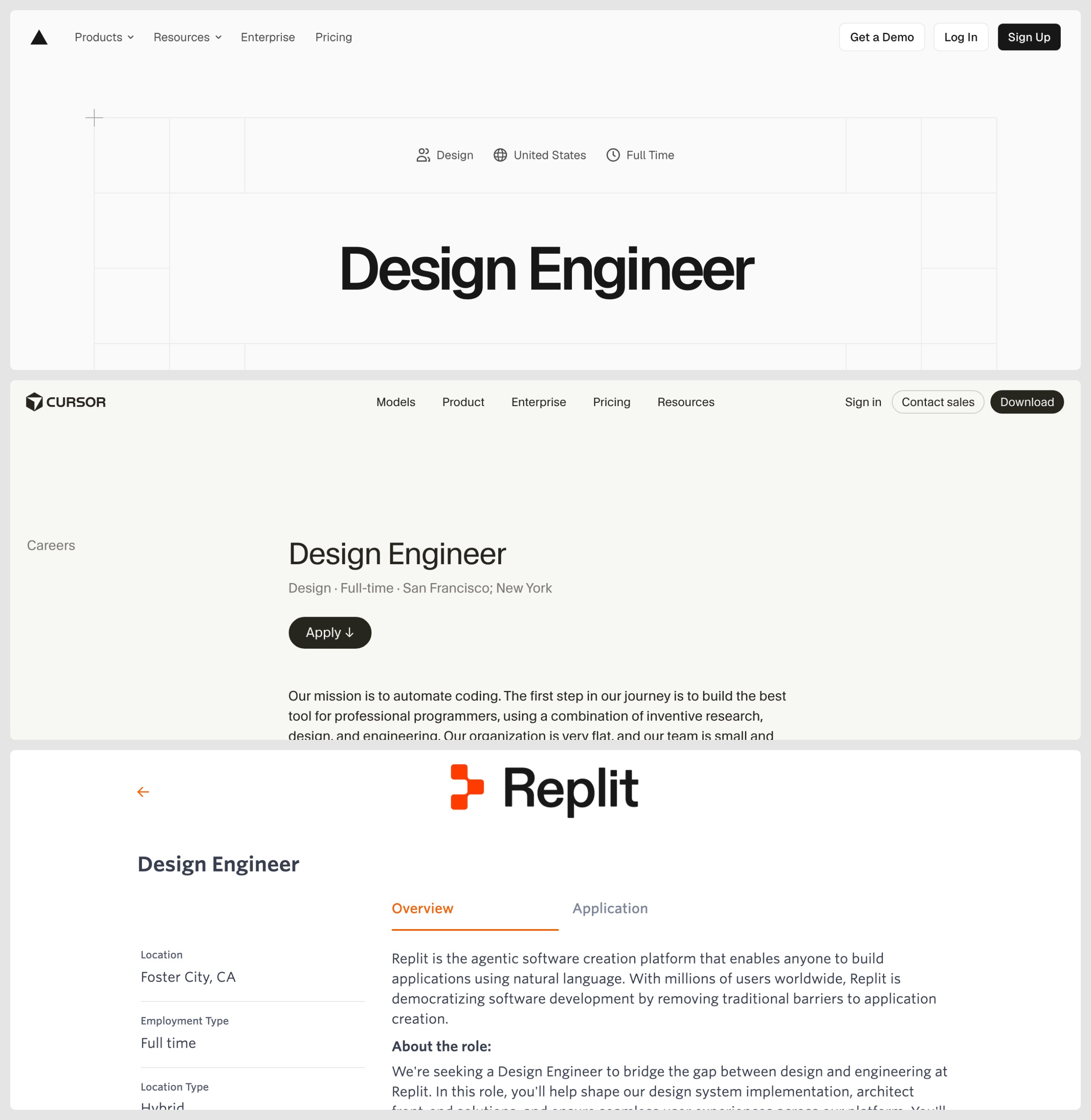
Openings move, so check what is current at vercel.com/careers, cursor.com/careers and replit.com/careers. designengineer.io, a board that lists only software roles, carried 45 open postings at the same time.
The postings describe two different jobs, and the difference matters whether you are applying or hiring. Linear was hiring a Design Engineer (Web & Brand) for its brand team, and Lovable a Staff or Principal Design Engineer, Web, to build its website with design and marketing. Neither is the job above. Chapter 1 separates the two tracks, and this chapter is about the product one.
A recruiter's study shows how narrow the product track still is. Hymera, a recruiting firm, reviewed more than 800 design and product engineer ads on 11 European platforms (data from July 2026, published August 2026). Only 76 of them unambiguously described a software design-and-build hybrid. Within Hymera's 76, 97% were senior or above, and 79% mentioned craft, taste or polish.
The job is real. It is also rare, senior, and judged on taste.
That sentence is the guide to becoming a design engineer in one line. The deliverable in it, the merged pull request, is what separates the role from a designer who prototypes. The question for this chapter is why the role turned up on job boards in 2025 and 2026 rather than in 2015.
Why now: implementation got cheap, handoff did not
The role exists now because the cost of implementing a design collapsed while the cost of handing one off stayed where it was. A design engineer is what a team looks like once it takes the cheaper path.
The "cheap" half is well documented. In the Stack Overflow 2025 Developer Survey (49,009 responses), 84% of developers used or planned to use AI tools. Of professional developers, 51% used them daily.
The tools that let non-engineers build have grown on the same curve. TechCrunch reported in March 2026 that Lovable had reached about 8 million users and $400 million in annual recurring revenue, up from $100 million in July 2025. A month later, TechCrunch reported that 30% of the apps on Vercel's platform had come from AI agents.
Designers are behind developers on the same curve, and that gap is where the role sits. In Figma's 2025 AI Report (2,500 respondents), 59% of developers used AI for core development work, against 31% of designers for core design work. The split is sharper at the task level: 68% of developers prompted AI to generate code, while 22% of designers used AI for first drafts of interfaces.
Developers adopted AI for core work first. Designers are catching up.
- Developers who prompt AI to generate code68%
- Developers using AI for core development work59%
- Designers using AI for core design work31%
- Designers using AI for first drafts of interfaces22%
Share of 2,500 product builders surveyed across seven countries.
The "handoff did not" half is documented by the same publisher. In Figma's Designer and Developer Trends 2025 report, 91% of developers and 92% of designers said the handoff process could be improved. Asked for the top challenge, 52% of developers named differences in assumptions between the two sides.
A vendor survey of 500 designers by CollabSoft found that 21% saw implementations match the design perfectly. Another 26% got a match only after extensive back-and-forth.
Put the two halves together. The path from a mockup to a merged change got no shorter. The path from a designer's intent to working code got much shorter.
A designer who takes the second path has stopped handing off. A team where that has happened is doing design engineering, whatever the org chart calls the person.
The manifesto makes the historical version of the argument: "'Product designer' became a job title for someone who never builds the actual product." The handoff is the recent invention. Designing in code is the older way of working, and AI made it affordable again.
What handoff costs, and why nobody has measured it
The cost of handoff is widely felt, and nobody has measured it. No credible source from 2024 to 2026 puts a number on the time or money a team loses to it. The cost is spread across rework, review queues and waiting, and no team owns that number, so nobody reports it.
You will meet one number in vendor decks and blog posts: 15 to 30% of developer time lost to handoff problems, credited to Nielsen Norman Group. Nielsen Norman Group never published it. Their article on the subject, Kelley Gordon's The Developer-Designer Relationship, is qualitative and carries no such figure. The number has been passed from one vendor to the next until it acquired a citation it never had.
So the honest picture is narrower. The survey data says the problem is near universal without saying what it costs. Two published cases go further, because they show what a team looks like when the handoff is removed rather than improved.
Alan, a French health insurer, published "Everyone can build" in November 2025. By then, 283 pull requests from non-engineers had shipped to production. Each one was paired with an engineer who owned the merge.
The people writing the changes were not engineers. The people reviewing them were.
Prelude, an onboarding and trust company, is a Modeinspect customer. Its published before-and-after reports that idea to merged pull request went from about 31 days on average to 13 days. Handoffs per feature fell from five or more to one in the same case study.
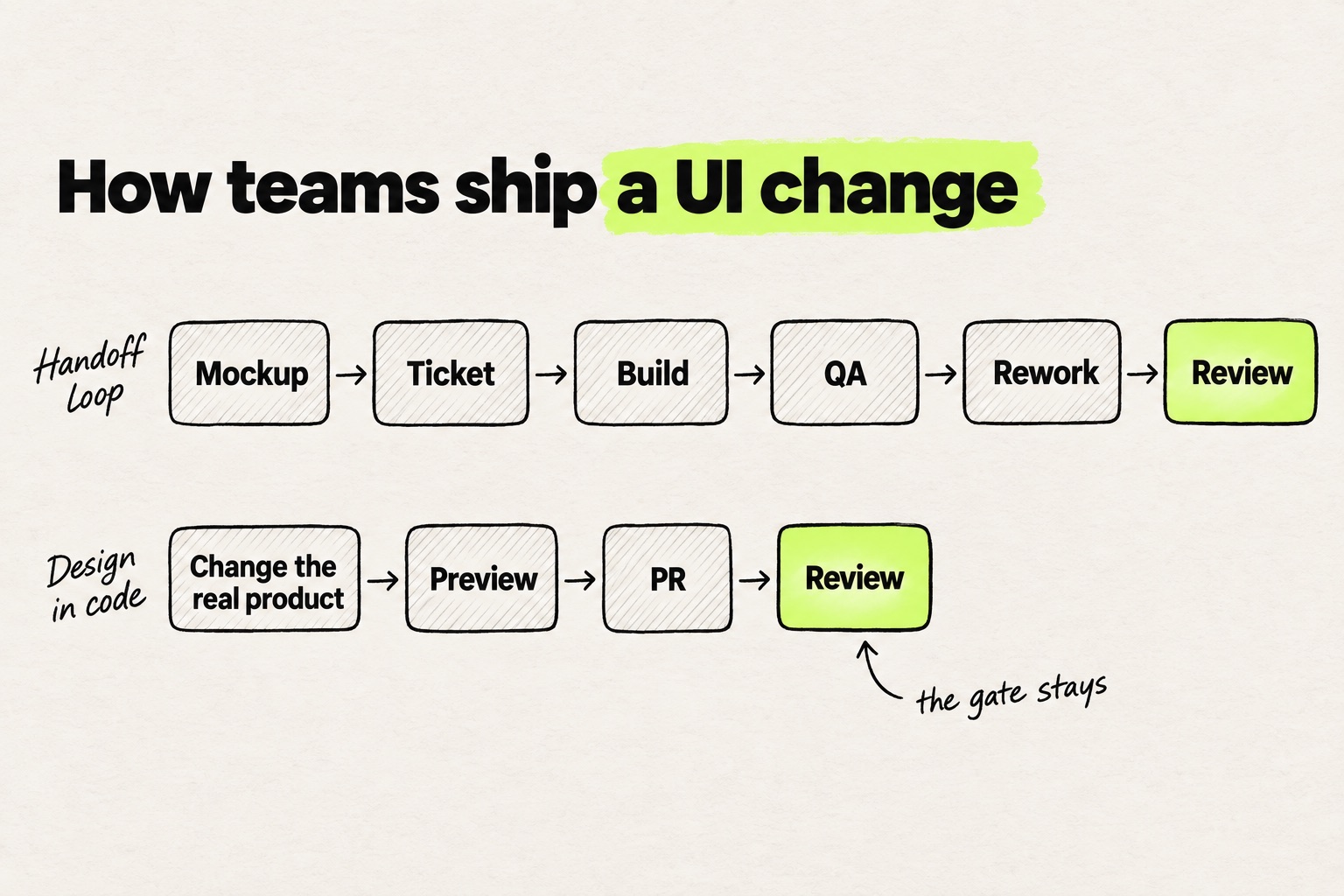
The diagram shows the shape of the difference. The handoff loop runs mockup, ticket, build, QA, rework, review. Design in code runs change, preview, pull request, review.
Review sits in both rows, and everything the design engineer removes sits before it. Why UX breaks after handoff walks the first loop in detail, drift by drift.
The case against the role
Three objections recur. Each appears below in its author's own words, and the next section answers each.
The competency gap
Carrie Webster, writing in Smashing Magazine, argues that "production-ready" has become a design deliverable before designers are equipped to produce it. Asking a senior UX designer to become a senior coder, she writes, is "like asking a master chef to also be a master plumber".
Her sharper point is about AI-generated code. A designer who ships code they cannot trace "is no longer an expert. They are now a liability." The expertise that made the designer valuable, in her account, does not transfer to judging code.
The design engineer title is a symptom
Anna Lefour, in UX Collective, named the pattern "the design engineer symptom". Job descriptions for the role contradict each other, she argues, because organizations are working out what they need in real time.
The title gets written down before the need is understood. Design engineering, in her reading, is "less a role to fill than a stance to take".
Yaron Schoen made a related argument on his blog. What is happening is not a new discipline but a title migration, because "the bar for 'can implement' collapsed".
The designers moving into the title were already building. What matters, he writes, is "the scope you're willing to own", and a title does not settle that.
Two jobs in one person, and the word "engineer"
The third objection lives in forum threads rather than essays, and reads best as discussion rather than verdict. In the Hacker News thread on the Hymera study, commenters argued that folding two roles into one person slows delivery. The same person becomes the bottleneck on both sides.
In Ask HN: Is Everyone an Engineer Now?, the objection was to the word itself. "Engineer" implies accountability when systems fail, and a title that borrows the word without the accountability devalues both.
The answers to the three objections
One line each, then each in full.
| Objection | Who, and where | The answer, in short |
|---|---|---|
| The competency gap: designers cannot be senior coders too | Carrie Webster, Smashing Magazine | Nobody asks them to be. The designer judges fidelity, the engineer reviews logic, and review gates every merge. |
| The title is a symptom of organizations scoping roles in real time | Anna Lefour, UX Collective, and Yaron Schoen, yaronschoen.com | Agreed. It is a symptom of implementation getting cheap, and half of a 900-designer sample already ships code. |
| Two jobs in one person slows delivery, and "engineer" implies accountability | Two Hacker News threads | The pull request is the accountability, and the one before-and-after on record shows fewer handoffs and less elapsed time. |
To Webster. The design engineer in this guide is not a senior coder, and nothing here asks for one. What to learn and what to skip has a long skip list: git internals, DevOps, algorithms, build pipelines, backend logic. What remains is five concepts learned inside the team's own codebase.
The liability she describes is a designer merging code nobody reviewed. That is a team that removed review, not a team with a design engineer. In this guide's definition, an engineer reviews every merge, and the chef is never asked to plumb. Her judgment point stands, and it is scoped: the designer judges fidelity, the tokens, components and states in the diff, and the engineer's review covers the logic.
To Lefour and Schoen. Agreed, on both counts. The title is a symptom of implementation getting cheap. In the Designer Fund and Foundation Capital AI in Design Report 2026, 50% of the 900+ designers surveyed had shipped AI-generated code to production. Only 20% called themselves design engineers. Chapter 3 reads that gap as the habit running ahead of the title. A stance that half of a 900-designer sample has taken is a job, whatever it ends up being called.
Schoen's test, the scope you are willing to own, is the right one. This guide names the scope as the merged pull request, and the ladder from product designer to design engineer is a self-assessment against it.
To the accountability objection. The pull request is the accountability. Alan pairs every non-engineer pull request with an engineer who owns the merge, and 283 had shipped that way by November 2025. The word "engineer" in the title does not move the gate. The engineer who approves the merge is accountable for what merges, exactly as before.
The accountability the word implies sits exactly where it did. The "slows delivery" worry runs against the one before-and-after on record above, where the number of handoffs fell and the elapsed time fell with it.
What this means for you
If you are a product designer, the question is whether your work ends in a file or in a merged change, not whether the title is real. Nothing in the objections above argues against the second, as long as an engineer reviews it.
If you lead a design team, hire for the product-track definition rather than the title, and read each posting for which track it describes. Expect the title to keep drifting, because Lefour is right that organizations write it down before they know what they need. Keep review with engineering, and the competency gap stays closed.
What changes is the unit of design work. It used to be a file that someone else turned into the product. It is now the change itself, reviewed by an engineer and merged. The wait does not survive the move.
Next chapter: Where you stand on the ladder from product designer to design engineer.