The design engineer career path runs through shipped work, not the title. This chapter is about the software role that designs and builds interfaces in code, not the mechanical design engineer who works in CAD.
Postings ask what you personally shipped. Interviews at Linear, Ashby and Paper test you by having you do the work. Pay follows level, and owning a scope is how you move up.
This chapter of the guide to becoming a design engineer walks the path in five steps, from reading a posting to choosing where to grow.
What the design engineer career path looks like
The title is the least stable part of it. There is no certification for the software role, as Mehmet Baytaş pointed out in the Q&A after his Hatch Conference 2026 keynote. Baytaş is creative director at Moment and was previously a design engineer on Attio's marketing team. In his account, a design engineer is whoever a company has given that title. The next company may call the same job front-end engineer or product designer.
This guide uses one definition throughout.
Some companies already level the role like any other. Ashby posts the title in three Americas openings that span five levels, from junior to senior staff, each with its own pay band. The junior opening asks for no more than two years of experience and projects "with at least a couple of users". Staff asks for "major contributions to a design system" and features built for hundreds of users.
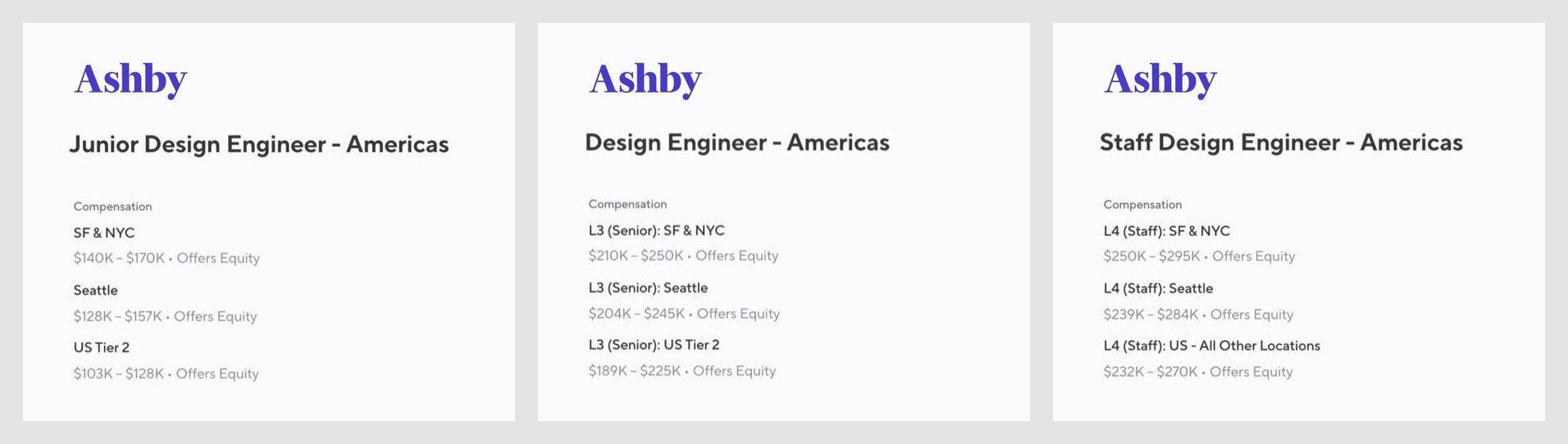
Many openings ask for senior experience. Replit asks for eight or more years of front-end work, Lovable's web role for ten, and Spear AI typically looks for seven years of design engineering. Paper's role is principal level. Among the postings in this chapter, Ashby's is the only junior opening.
The doors are open from both sides. Vercel's posting says "There is no required path into this role" and names product design, front-end engineering and creative development. What it cares about is "the quality of what you have shipped and the judgment behind it."
For a product designer, the first step is shipping at your current job. The three rungs chapter maps that climb, and it usually takes weeks, not years.
Step 1: Read the design engineer job description for four things
The same title covers several jobs. A design engineer job description tells you which one it is. Read it for four things: the track, who owns production, what you will own, and how you will be judged.
The track. Product postings name a surface inside the app. Ramp's design engineer owns "key surfaces end to end". Marketing postings name the website. Perplexity wants someone to ship "product launch pages and evergreen marketing pages". Chapter 1 separates the two tracks, and a portfolio for one does not fit the other.
Who owns production. None of these postings says on-call. Production shows up in other words, so look for them:
- "ensure that our products remain live, performant and secure" (ElevenLabs)
- "Customer issues and investigations are distributed across the team" (Ashby)
- A DevOps line listing GitHub Actions, Grafana and Terraform (Lovable)
Each of those means some of the running of production is yours. That is Baytaş's warning from the case against the role, read off the posting.
Vercel's posting shows the other pairing. It asks the hire to "Own quality after launch" and names "a dedicated engineering team" alongside. Quality stays yours and operations stay with engineering. That is the product-track job this guide describes.
What you will own. Baytaş built a word cloud from design engineer postings for his talk, and "ship" and "ownership" were the largest words in it. September's postings bear him out. All but one of those named here used the word ship, and most asked the hire to own something. At Vercel and Autumn it was a product surface, at Perplexity the work "from Figma handoff to production", and on Lovable's brand team a generation system. The thing named after "own" is the job.
How you will be judged. The requirements list says what the portfolio must show, and some postings describe the interview too. Steps 2 and 3 cover both.
One more line to read for is design. In the same Q&A, Baytaş drew the difference between a design engineer and a front-end developer: the design engineer is expected to design. Some teams with a strict design system do not need front-end engineers with design skills, and do not hire the role. A posting that asks for years of front-end work and barely mentions visual design is closer to a front-end job, whatever its title. Design leads writing these postings get their own chapter: building a design engineering team.
Step 2: Build a design engineer portfolio of shipped work
A design engineer portfolio shows work that shipped, with proof that it did. Static shots on Dribbble show taste. Most postings that describe a portfolio ask for work that shipped or runs.
| Company | What the posting asks for (checked 28 September 2026) |
|---|---|
| Vercel | "Your work shows what you personally identified, designed, built, shipped, and learned after launch." |
| Autumn | "a portfolio of shipped interfaces where you did both the design and the front-end build, and can explain why each decision was right" |
| Ramp | "A portfolio that shows high visual and interaction craft in live experiences or working prototypes" |
| Linear (Web & Brand) | "A portfolio or Twitter profile showcasing a range of technical skills, a creative use of code, and prototyping skills" |
| ElevenLabs | "artifacts such as past projects, designs, or GitHub contributions" |
| Ashby (mid and senior) | "experience designing products and shipping code to hundreds of users (even if through side projects)" |
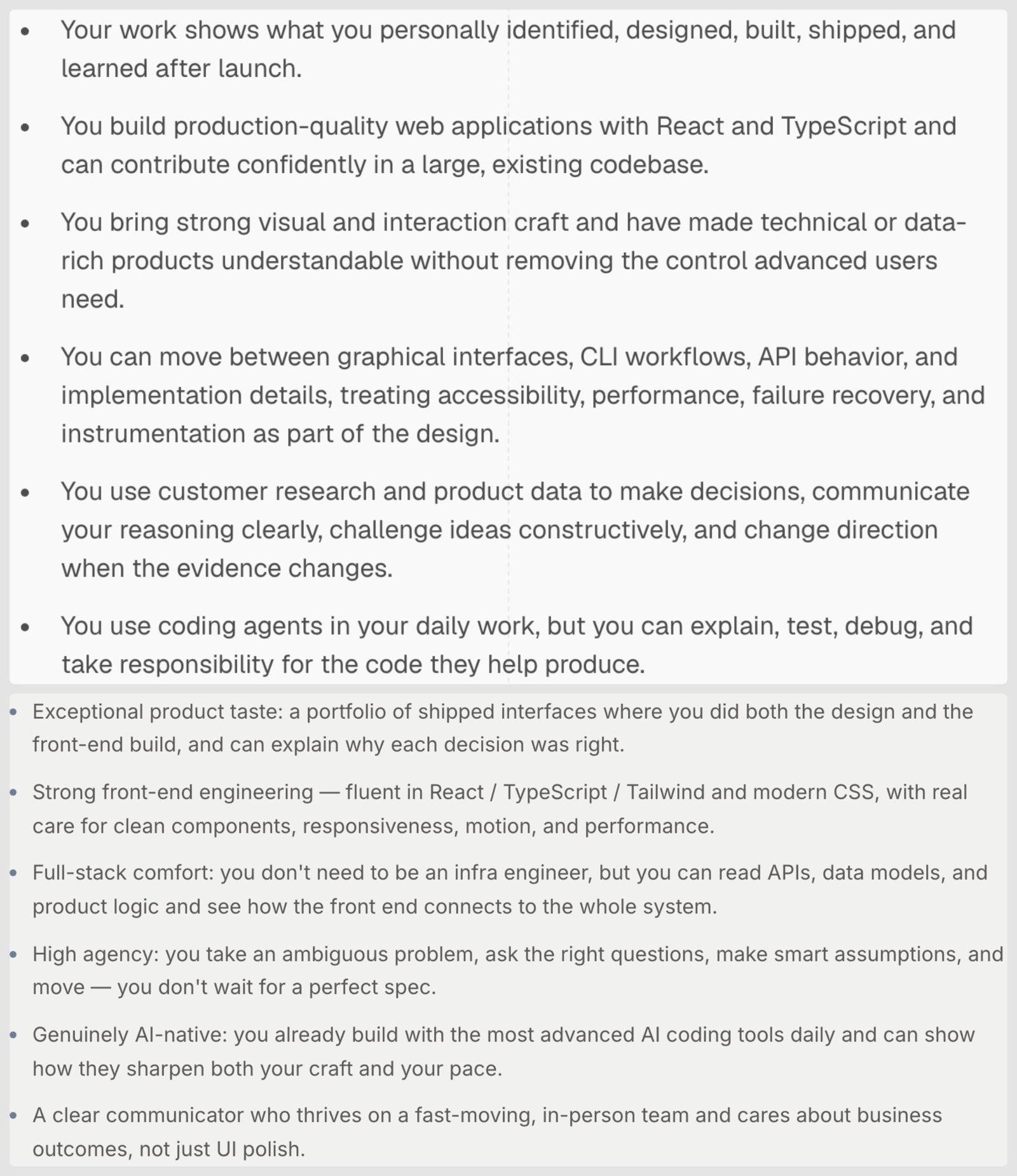
Current openings are on each company's careers page, such as Autumn's and Linear's.
Build each portfolio entry around five parts. Vercel's line, what you identified, designed, built, shipped and learned after launch, maps onto them.
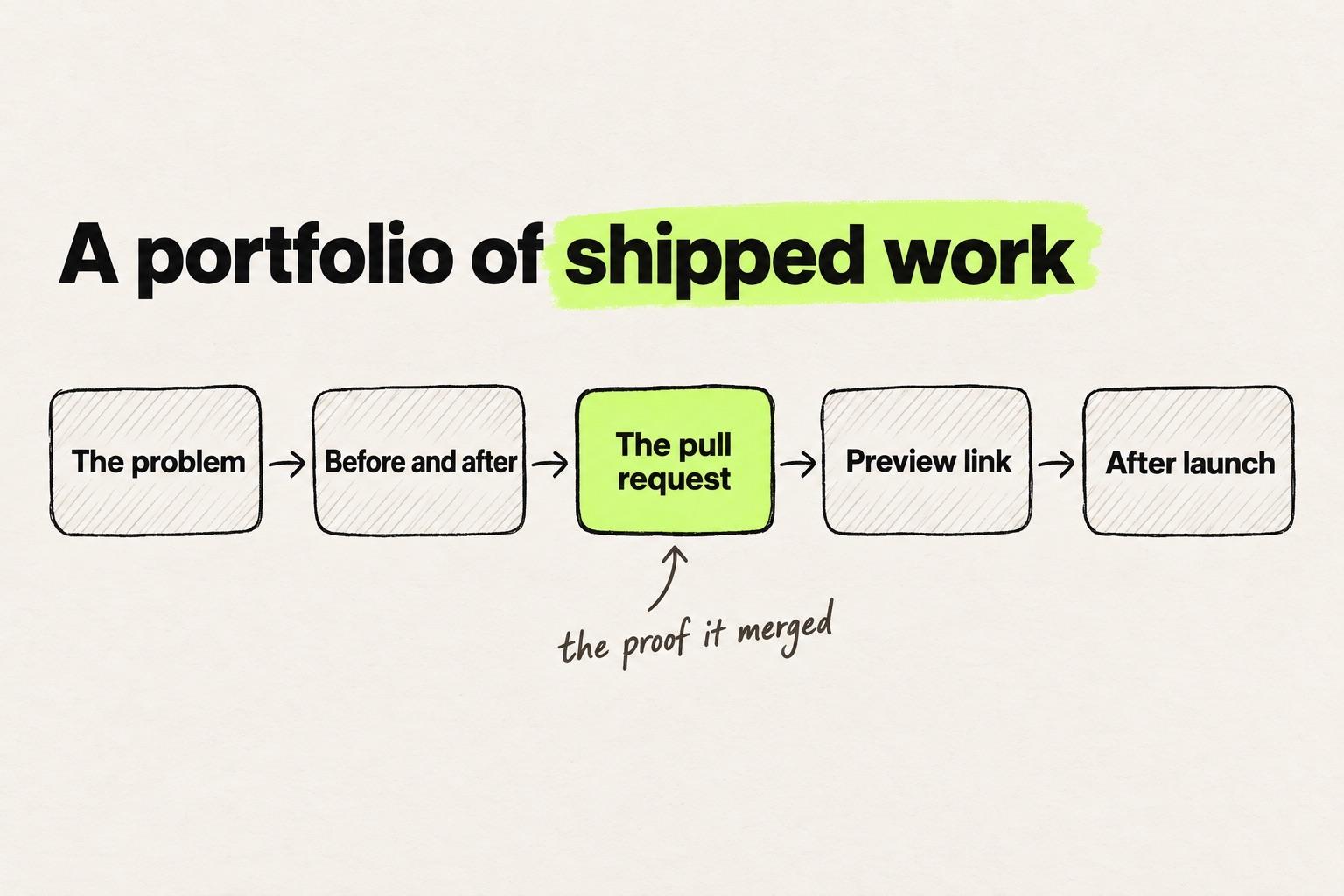
- The problem. One or two sentences on what was wrong and who noticed it.
- Before and after. Screenshots or a short screen recording of the real product, both states.
- The pull request. A link if the repository is public. For a private one, a screenshot of the pull request page with the description and review, shared with your employer's permission.
- A preview or production link. Something a reviewer can click, so the work runs rather than sits in a frame.
- After launch. What changed for users, what you fixed in a follow-up, what you would do differently.
Design system work belongs in it, and it is the work that most needs the pull request. Maggie Appleton noted in A Collection of Design Engineers that work like "advocating for robust design systems and cleaning up legacy code" is hard to share. A merged pull request that swaps hardcoded values for tokens shows it in one link. Small changes count. A first pull request of a few lines, the size the first pull request walkthrough recommends, is shipped work.
If your day job gives you nothing public, build in public. In "Animating in public", Emil Kowalski describes posting what he built on Twitter so employers could see it. A video recreating Vercel's tab component "changed everything", and he later joined Vercel. Linear's posting accepts that kind of feed, and Ashby's counts side projects with real users.
Match the portfolio to the track. Lovable's web role asks for "landing pages and advanced web interactions" and tells candidates without them to look at its other roles. A portfolio of settings screens will not get that job.
Step 3: Prepare for a design engineer interview that asks you to do the work
Most design engineer interviews that companies publish include a work sample, not a quiz. You walk through past work, then build something with the team or on your own. The formats differ in length and in whether you are paid.
| Company | What they publish (postings checked 28 September 2026) | The work sample |
|---|---|---|
| Linear | Usually three to four conversations, then a work trial. Most processes take four to six weeks | Paid work trial of 2 to 5 days on a real project |
| Ashby (in the posting) | A 30-minute intro where you screen-share your work, then a second and a final round | A 1-hour live technical screen and a design take-home of about 3 hours, one in each round |
| Paper (job post) | Take-home, trial, or both | Paid trial project of 1 to 2 weeks to "ship a complete feature" |
| Lovable (in the posting) | Several technical interviews, including a front-end screen "at the same level we expect from Product Engineers" | Paid trial work in some cases |
Linear's trial is the one written up in most detail. Its work trial post describes a paid period in which "a candidate works with our team on a real project that we plan to implement". For a designer, the example project was designing a way to resolve comments. Linear says it looks for craft, judgment, ownership and clarity.
Ashby's posting spells out its rounds. The final round is three hours: "a deep dive into a past design system or design project, a design system interview", plus whichever work sample you did not do earlier. "There are no leetcode or whiteboard exercises", and candidates who get no offer get feedback.
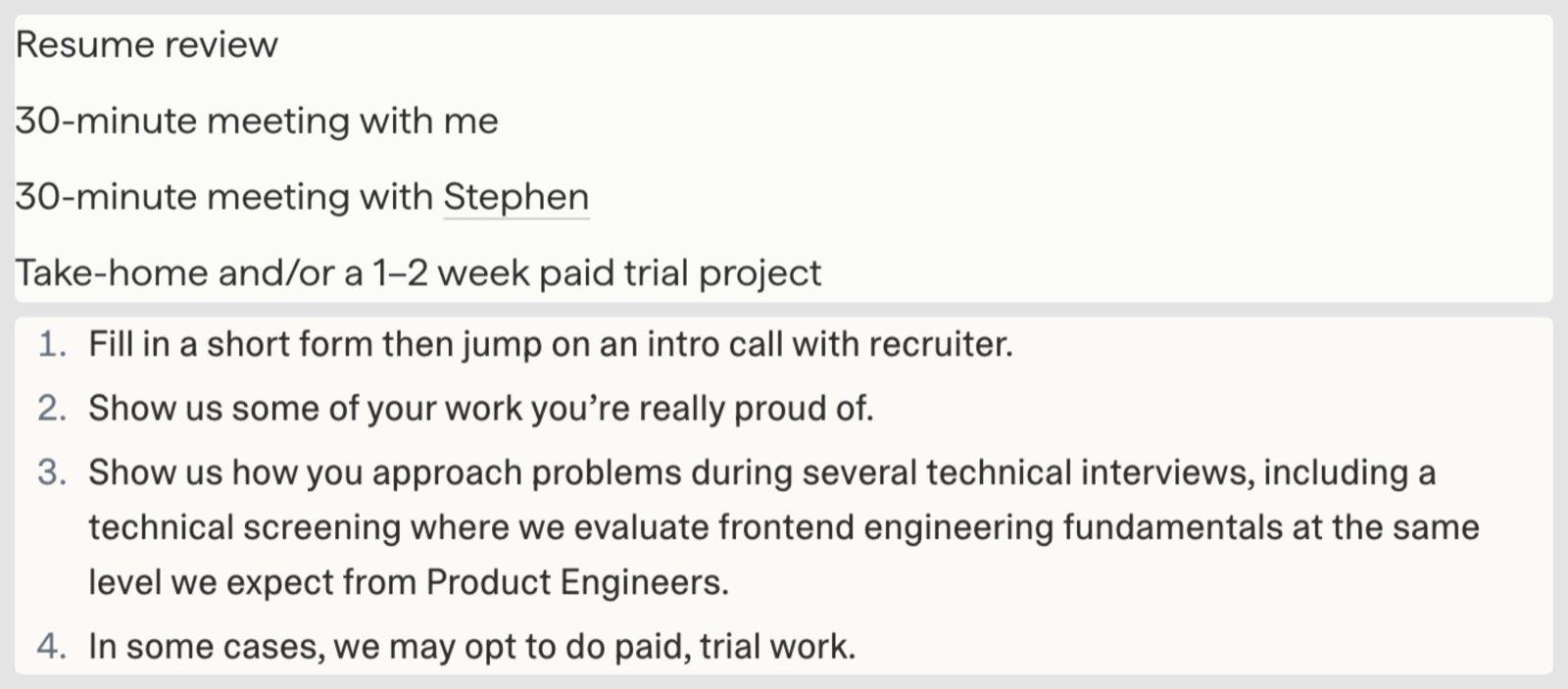
Vercel publishes no interview process for the role. Prepare for what its posting says it judges: shipped quality, the judgment behind it, and agent-written code "you can explain, test, debug, and take responsibility for".
The on-site version exists too. Business Insider reported in June 2025 that Cursor's final step for shortlisted candidates was two days in its office, working on a real project and demoing it.
Design engineer interview questions to prepare
The likely questions follow from those formats. Prepare an answer to each:
- Walk us through past product work and the trade-offs behind it. Linear and Ashby both ask. Pick an entry from Step 2 and tell it from problem to after launch.
- How would you structure this component? Ashby runs a design system interview and describes "writing design system specs collaboratively". Expect props, variants, tokens and naming.
- Explain this code your agent wrote. Vercel's posting says it judges this. Read your own diffs until you can.
- What would you ship in the time you have? Paper's trial asks for "a complete feature". Scope to something you can finish, and say early what you would cut.
- Show us front-end fundamentals. Lovable screens at product-engineer level for its web role. Know layout, state, accessibility and performance for your track.
Step 4: Check the design engineer salary ranges postings print
Design engineer salary depends on level and city, and the most reliable numbers are the ranges companies print in their own postings. Every company in the table also offers equity, and Vercel's posting mentions a bonus.
| Company and role (checked 28 September 2026) | Location | Printed range |
|---|---|---|
| Ashby, Junior Design Engineer | San Francisco and New York | $140K to $170K |
| Ashby, Junior Design Engineer | US Tier 3 locations | $101K to $124K |
| Ashby, Design Engineer (mid, L2) | San Francisco and New York | $160K to $190K |
| Ashby, Design Engineer (senior, L3) | San Francisco and New York | $210K to $250K |
| Ashby, Staff Design Engineer (L4) | San Francisco and New York | $250K to $295K |
| Ashby, Senior Staff (L5) | San Francisco and New York | $272K to $323K |
| Vercel, Design Engineer (product) | San Francisco | $208,000 to $312,000 |
| Replit, Design Engineer (design system) | Foster City, CA | $180K to $290K |
| Ramp, Design Engineer | New York, by location and level | $172K to $440K |
| Perplexity, Design Engineer (growth and marketing) | San Francisco and New York | $180K to $300K |
| Virio, Founding Design Engineer | San Francisco | $150K to $250K |
| Ashby, Design Engineer (mid, L2) | London | £72K to £88K |
| Ashby, Design Engineer (senior, L3) | London | £123K to £149K |
| Granola, Design Engineer | London | £100K to £130K |
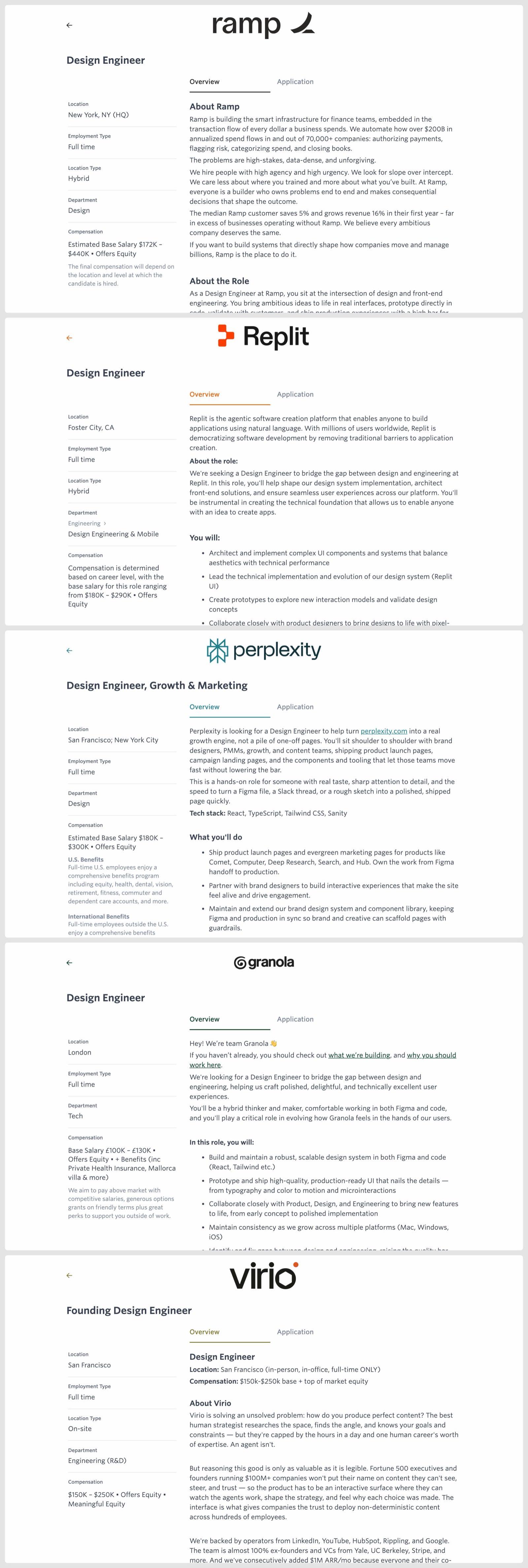
Openings rotate, so check what is current at jobs.ashbyhq.com/ashby, vercel.com/careers and the other companies' careers pages. Linear, Lovable, Paper and Autumn printed no pay. The Design Engineer Report will publish counts of open postings and printed ranges across job boards.
Level moves pay most. Within Ashby's ladder, the staff band starts where the senior band tops out, and the junior band in a Tier 3 city starts at $101K. The one marketing posting that printed pay, Perplexity's, sits close to Replit's product role.
Baytaş's advice on moving up was to own a part of the business outright: the website, the design system or the brand. In his telling, a founder or manager who can hand you a whole area and stop worrying about it will pay more for that. Ashby's staff requirement, major contributions to a design system, writes the same idea into a level.
Step 5: Choose a scope that will outlast the title
Build your career on a scope, because the title may not last. Baytaş predicted that branding, marketing engineering and product engineering will become more popular than design engineering, because they are enduring scopes. Design engineer is the current name for people who cover them.
Pick the one you want to own. Product engineering means a surface inside the app and its design system. Marketing engineering means the website, launches and motion. Brand means the systems that keep a company's look consistent as it grows. Each has its own portfolio, its own interview and its own name at the next company.
Where your team stands matters too. If your company already has a strict design system that engineers build to, it has an owner, so look at a product surface or the website. If it has none, the design system is open, and that can be your scope.
Start this week with one entry. Take the last change you shipped, or the next one, and write it up in the five parts from Step 2 while the pull request is fresh. If that change is not a merged pull request yet, the three rungs show the next step. If you lead a design team and want to hire for this, go to the next chapter, for design leads.